Why Invest in Dubai International Academic City?
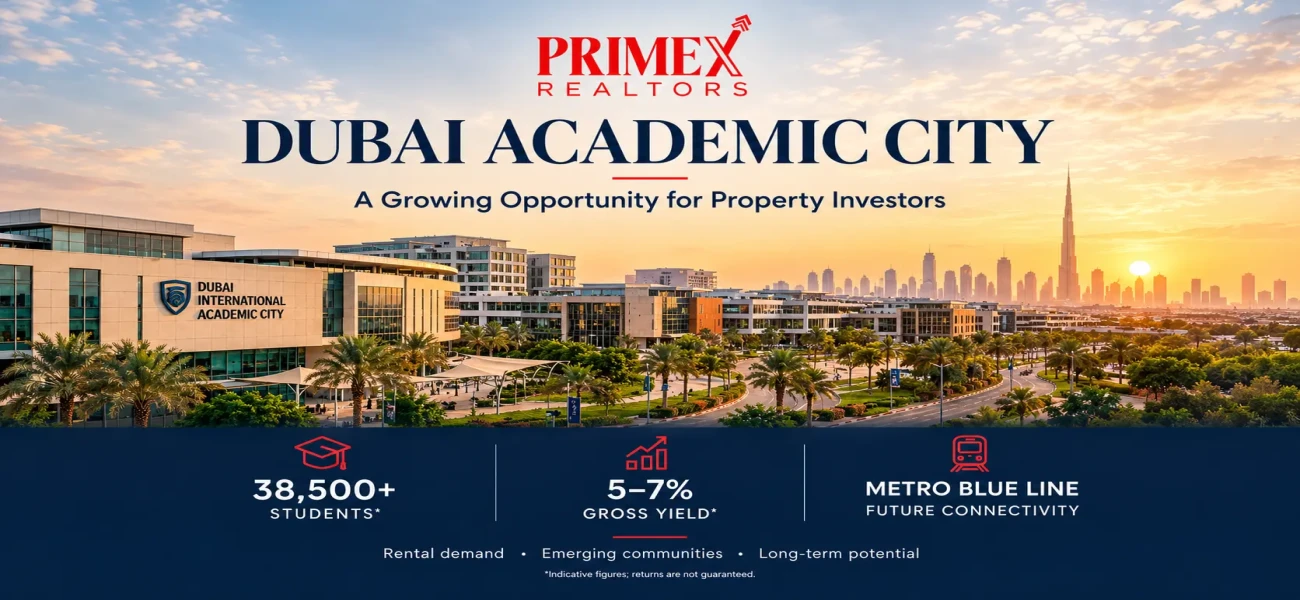
Why
Invest in Dubai International Academic City?
Rental
Demand, Upcoming Projects and Potential ROI (2026–2030)
Dubai International Academic City (DIAC) is
worth considering for investors who want exposure to a specialised rental
market rather than relying only on tourism or luxury-home demand. Its long-term
investment case is built around universities, a growing student population,
demand from academic staff and visiting professionals, and improving
connectivity. The opportunity is promising, but returns depend on the specific
property, purchase price, building quality, service charges and how effectively
the home is marketed.
1. Why Academic City can attract property investors
DIAC is one of Dubai’s established
higher-education clusters. Its official community information lists 27-plus
educational institutions and more than 500 programmes, while TECOM Group
reported that DIAC and Dubai Knowledge Park together hosted over 38,500
students at the end of the 2024–25 academic year—a 15% increase year on year. A
separate study by the two education hubs forecasts Dubai’s higher-education
enrolment to grow by more than 40% by 2030 compared with 2024–25. These figures
support the case for a sustained pool of potential tenants, although they do
not guarantee that every student will rent a private apartment in DIAC.
The area can appeal to several tenant
groups: students who want to live close to campus, groups of students sharing a
larger apartment, university lecturers and administrative staff, parents
visiting students, and professionals working in nearby Dubai Silicon Oasis and
other employment districts. A well-maintained studio or one-bedroom unit may
suit an individual tenant, while a two-bedroom apartment can work for sharing
or a small family. Larger townhouses and villas are more naturally suited to
families and academic professionals than to individual students.
2. How universities and schools support rental demand
The strongest demand driver is the
concentration of universities and specialist institutions. Students often value
a manageable commute, furnished accommodation, reliable internet, security and
access to shops and transport. International students may also prefer a
ready-to-move-in property and flexible leasing support. Parents and visiting
faculty can create additional short-stay demand, subject to building rules and
local regulations.
Schools can support demand from families
living in the wider area, but DIAC is primarily known as a higher-education
district. Investors should check the actual distance to the schools their
target tenants are likely to use, as well as school transport routes. It is
safer to assess each property’s access to campuses, supermarkets, healthcare,
bus connections and road links than to assume that the presence of educational
institutions alone will ensure full occupancy.
3. Upcoming projects and infrastructure to watch
Greenz by Danube
Announced in April 2026, Greenz by Danube
is a planned master community in Academic City offering three- and four-bedroom
townhouses and five-bedroom villa formats. The developer has announced starting
prices from AED 3.5 million and an expected handover in Q4 2029. The community
is planned to include extensive lifestyle amenities. Because it is a
townhouse-and-villa development, its likely tenant pool is families and
higher-income professionals rather than students seeking low-cost rooms. Buyers
should verify the latest price list, unit availability, payment-plan terms and
construction milestones directly with the developer.
Tilal Binghatti
Property Finder’s Academic City new-project
listings also identify Tilal Binghatti, with a listed launch price from AED 4.2
million and an expected delivery in Q4 2029. The listed product is focused on
larger four- to seven-bedroom homes, so its rental strategy is likely to be
family-oriented. Availability and sales status can change; confirm the latest
details with the developer before making a decision.
Dubai Metro Blue Line
The planned Dubai Metro Blue Line is an
important infrastructure factor to monitor for Academic City and neighbouring
communities. Improved public transport can make an area more attractive to
students and staff who prefer not to drive. The effect on rents and resale
values will depend on the final station access, walking distance, delivery
timetable and the degree to which the benefit is already reflected in property
prices. Do not pay a premium based only on a future transport promise.
Beyond these named developments, investors
should review the wider supply pipeline around Dubai Silicon Oasis, Liwan and
neighbouring residential districts. More housing can improve amenities and
create a stronger community, but it can also give tenants more choice. New
supply is therefore both a growth opportunity and a factor to include in rental
and resale assumptions.
4. What rent could an investor expect?
Rents vary materially by building, layout,
size, furnishing, maintenance, parking and whether the unit is leased on a
whole-apartment or room-by-room basis. Public transaction data for Academic
City reported an average annual rent of about AED 31,506 across recorded
rentals in the period shown, with many transactions concentrated in smaller
units. That average should not be treated as a guaranteed market rent for every
bedroom type.
|
Property type |
Indicative annual rent |
Likely tenant profile |
|
Studio apartment |
AED 22,000–35,000 |
Single student or young professional |
|
1-bedroom apartment |
AED
35,000–50,000 |
Student,
couple or staff member |
|
2-bedroom apartment |
AED 50,000–75,000 |
Sharing students, colleagues or small family |
|
3-bedroom townhouse / villa |
AED
110,000–160,000+ |
Family or
higher-income professional household |
These are broad underwriting ranges for
initial planning, not verified quotes for a specific unit or a promise of
achievable rent. The villa range is especially sensitive to community, size,
furnishing and amenities; newer premium projects may command different rents
once completed. Before buying, compare recent Dubai Land Department rental
registrations where available, current listings for genuinely comparable units,
and the building’s own leasing history.
5. Example ROI calculation
Rental yield is the annual rent divided by
the total purchase price. The example below illustrates the calculation for a
hypothetical ready apartment; it is not a valuation or a forecast for a
particular building.
|
Assumption |
Illustrative example |
|
Purchase price |
AED 600,000 |
|
Annual rent |
AED 42,000 |
|
Gross rental yield |
AED 42,000 ÷ AED 600,000 = 7.0% |
|
Illustrative annual running costs |
AED 8,000
(service charges, management, maintenance and vacancy allowance) |
|
Net rental income before finance and tax considerations |
AED 34,000 |
|
Illustrative net yield on purchase price |
AED 34,000 ÷
AED 600,000 = 5.7% |
For an actual purchase, include acquisition
costs such as Dubai Land Department fees, agency commission and any
mortgage-related costs in the total investment basis. A more complete net-yield
calculation should also include insurance where applicable, leasing fees,
periods without a tenant, repairs and any owner-paid utilities. If the property
is bought off-plan, rent generally begins only after handover and successful
leasing; do not calculate an immediate rental yield by combining an off-plan
price with rent from an unrelated existing unit.
6. What ROI is realistic over the next few years?
For a ready, well-priced apartment with
reliable tenant demand, an investor might use a gross yield planning range of
roughly 5%–7% as a starting scenario and then test whether the numbers still
work after costs. This is an underwriting assumption, not an official Academic
City average or a guaranteed return. Smaller units may produce a higher
percentage yield than larger homes, while larger townhouses can appeal to a
different tenant segment and may have a longer leasing period.
Capital appreciation is more uncertain than
rental income. Student growth, new community facilities and better transport
access could support values over time, but future price increases cannot be
reliably promised. The completion of new projects may increase competition, and
any market-wide slowdown can affect resale prices. Investors should model a
flat-price scenario as well as an upside scenario, and should be comfortable
holding the property if resale takes longer than expected.
7. How to choose the right property for rental income
·
Prioritise a practical commute
to the target campus or employment area, not just a neighbourhood label.
·
For student-focused demand,
compare studios and one-bedroom units, and check whether the building permits
the intended occupancy and leasing arrangement.
·
Inspect internet availability,
furnishing quality, air-conditioning, noise, security, maintenance response and
public transport access.
·
Request the latest
service-charge statement and calculate yield using the actual asking price and
realistic rent—not the highest listing in the area.
·
Check comparable registered
leases, current competing listings, expected handover dates and the number of
similar units being delivered nearby.
·
For off-plan purchases, review
the developer’s track record, escrow arrangements, payment schedule, contract
terms and the stated completion date.
Conclusion: Is Academic City worth considering?
Academic City has a clear investment story:
an established education cluster, a sizeable and growing student population,
demand from university staff and families, and future infrastructure that may
improve accessibility. Greenz by Danube and Tilal Binghatti add a visible
pipeline of larger homes expected around 2029, while the planned Metro Blue
Line is a key long-term factor to monitor. For investors seeking rental income,
the best opportunity is not simply to buy because universities are nearby; it is
to select a property whose price, achievable rent, operating costs and tenant
profile make sense together. A carefully selected ready apartment may provide
earlier income, while off-plan homes offer a longer-term strategy with
additional delivery and market risk.
Sources and verification notes
·
Dubai International Academic
City / Dubai Knowledge Park: student growth announcement (15 January 2026):
https://diacedu.ae/media/press-release/student-body-grows-15-at-dubai-international-academic-city-and-dubai-knowledge-park
·
DIAC and Dubai Knowledge Park:
higher-education enrolment outlook to 2030:
https://diacedu.ae/media/press-release/press-release-higher-education-enrolments-in-dubai-to-increase-40-by-2030-new-study-by-dubais-leading-education-hubs-finds
·
Danube Properties: Greenz by
Danube announcement (20 April 2026):
https://danubeproperties.com/danube-properties-unveils-aed-3-5m-greenz-master-community-in-dubais-high-growth-academic-city/
·
Property Finder: new projects
in Academic City:
https://www.propertyfinder.ae/en/new-projects/lp/dubai/academic-city
·
Bayut: Academic City rental
transaction analysis:
https://www.bayut.com/property-market-analysis/transactions/rent/property/dubai/academic-city/
·
Cushman & Wakefield Core:
Dubai residential market, Q4 2025:
https://www.cushwake.ae/en/marketbeats/marketbeat-residential-q4-2025-dubai-uae
Important: Rental ranges
and ROI examples in this article are indicative planning estimates, not
financial advice or guaranteed returns. Prices, availability, rents, project
status and handover dates can change. Verify current figures with the
developer, Dubai Land Department records and a licensed local real-estate
professional before investing.